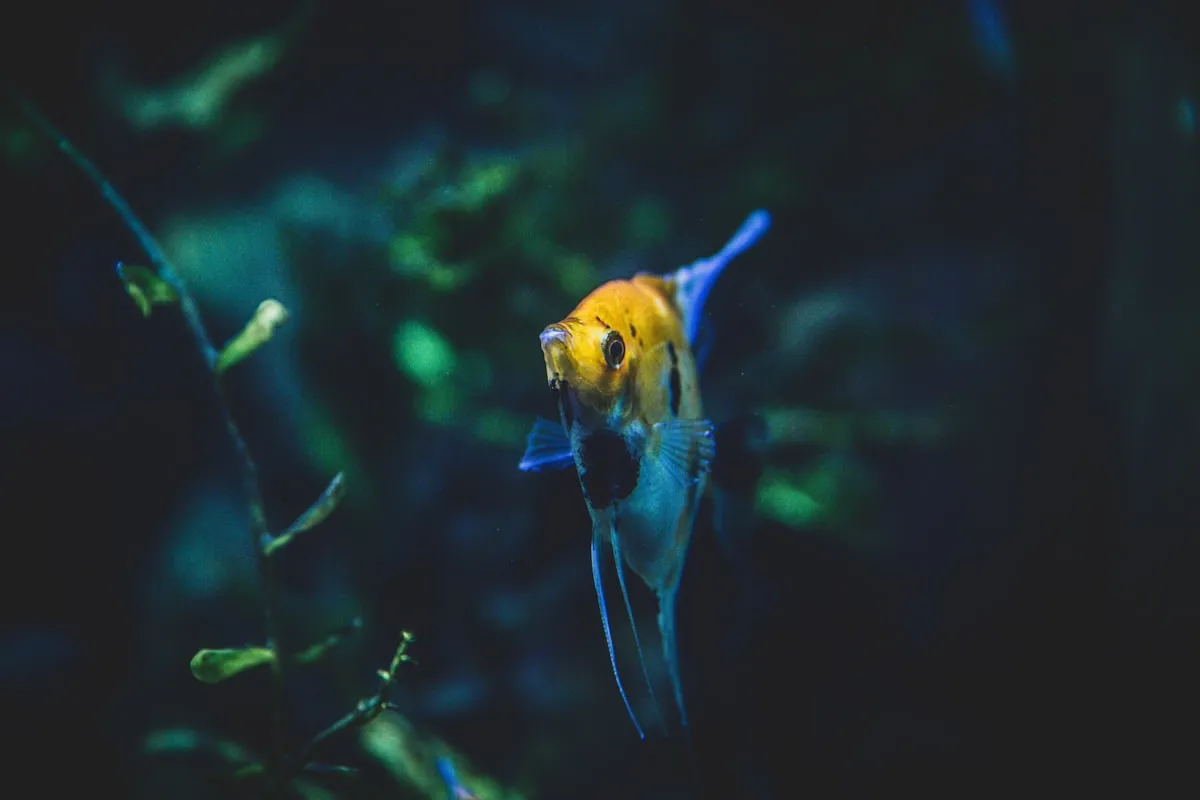
Angelfish Species Profile and Compatibility Guide
January 7, 2026 · 5 min read · Photo: Max Letek / Unsplash
Angelfish are one of those species that pull people into the hobby and then never quite let them leave. That tall, graceful silhouette gliding through a planted tank is the reason a lot of us got a second tank in the first place. But “angelfish” covers a lot of ground, from wild-caught fish barely touched by breeding programs to the marbled, veiltailed show fish sold at nearly every pet store. Knowing the difference matters for how you set up the tank, who you keep them with, and whether you’ll ever see them spawn.
Wild-Type vs. Domestic Angelfish
The freshwater angelfish in the trade almost all trace back to Pterophyllum scalare, a cichlid native to slow-moving tributaries of the Amazon basin. True wild-type scalare are silvery with four to five bold black vertical bars, a slightly less exaggerated fin spread than what most hobbyists picture, and a build that reads as more athletic than ornamental. A rarer relative, Pterophyllum altum, is the deep-bodied “Altum angelfish” prized by discus-style keepers; it needs softer, warmer, more acidic water than the average community tank provides and isn’t a great first angelfish.
Domestic angelfish are the product of decades of selective breeding for color and pattern: koi, marble, platinum, zebra, black lace, gold, smokey, and long-fin veiltail forms are all the same species reshaped by selection, not different fish. They’re generally hardier and more tolerant of a wider pH and hardness range than their wild ancestors, which is why they’re the ones sold as beginner-friendly. If you want the wild look with domestic ease of care, some breeders offer “wild-type” strains that keep the natural bar pattern without the extra fussiness of true wild-caught stock.
Tank Setup and Water Parameters
Angelfish are taller than they are long, and that vertical body shape matters more than gallon count alone. A tank that’s at least 20 inches tall (top to bottom) gives their fins and body room to fully extend; a short, shallow tank looks cramped for them even at a generous volume. As a rule of thumb (not a hard rule), plan on at least 29 gallons for a single angelfish and closer to 55 gallons for a group or breeding pair with tank mates, since adults can reach roughly 6 inches of body length with fins that add considerably more.
Domestic angelfish do well in the same water most community fish tolerate: pH around 6.5 to 7.5, moderate hardness, and stable temperatures in the mid-to-high 70s Fahrenheit. Wild-type and Altum angelfish appreciate softer, more acidic water, often pH 6.0 or below, and warmer temperatures near 84 to 86°F, closer to their native river conditions. Whatever the strain, run the tank through a full nitrogen cycle before adding fish, and keep ammonia and nitrite at zero. Angelfish aren’t unusually sensitive, but like most cichlids they show stress and color loss quickly when water quality slips.
Choosing Tank Mates
Angelfish are semi-aggressive, slow-moving, and mouth-forward predators by nature, which shapes every tank mate decision. Fin nippers like tiger barbs and serpae tetras are a poor match; angelfish trail long fins that are an open invitation. On the flip side, anything small enough to fit in an adult angelfish’s mouth, including neon tetras and other nano fish, is at real risk of becoming a meal once the angelfish matures, even if the two got along fine as juveniles.
Good middle-ground tank mates tend to be similarly sized and calm: rummy-nose tetras, larger tetra species, corydoras catfish working the substrate, bristlenose plecos, and dwarf cichlids kept with adequate space and hiding spots. Gouramis can work but watch for territorial friction. Avoid other boisterous cichlids that will compete for the same water column and pester the angelfish’s fins. As always, stock gradually and watch behavior for the first few weeks rather than assuming a stocking list guarantees peace.
Breeding Basics
Angelfish are egg-layers that form pair bonds, and sexing them visually is genuinely hard outside of spawning behavior; most keepers let the fish pair themselves off from a group of six or more juveniles rather than trying to buy a “male” and “female.” A bonded pair will clean a flat vertical surface (a piece of slate, a broad leaf, a length of PVC pipe) and the female lays a row of eggs that the male fertilizes as she goes.
Both parents typically guard and fan the eggs, and later shepherd the free-swimming fry. It’s common, especially with a pair’s first one or two spawns, for the parents to eat the eggs or fry; this usually isn’t a sign of anything wrong; it often resolves as the pair gains experience. Some breeders remove the eggs to a separate rearing tank with an air-driven sponge filter and gentle water movement to sidestep this entirely. Slightly warmer, very clean, mineral-appropriate water tends to encourage spawning, and stability matters more than any single “magic” parameter.
FAQ
How big do angelfish get, and how many gallons do they need? Adults typically reach around 6 inches of body length, with their fins adding significantly more height and length overall. A single angelfish does reasonably well in a 29-gallon tank, but a pair or small group, especially one meant for breeding, is better suited to 55 gallons or more in a tank with real vertical height.
Are wild-type angelfish harder to keep than domestic ones? Generally yes. Wild-type and especially Altum angelfish prefer softer, more acidic, warmer water closer to Amazonian river conditions, while domestic strains have been bred over generations to tolerate a wider range of typical tap-water parameters.
Can angelfish live with neon tetras? It’s risky long-term. Neon tetras are small enough that an adult angelfish may eventually eat them, even in setups where juveniles coexisted peacefully. Larger tetra species are a safer pairing.
Why do my angelfish keep eating their own eggs? This is common, especially in a pair’s first few spawns, and usually reflects inexperience rather than a health or water quality problem. Many pairs improve with repeated spawning attempts, and some keepers pull the eggs to a separate rearing setup to avoid the issue altogether.
- angelfish
- freshwater cichlids
- species profile
- tank mates
- breeding
- Pterophyllum scalare
- aquarium compatibility
- beginner fishkeeping