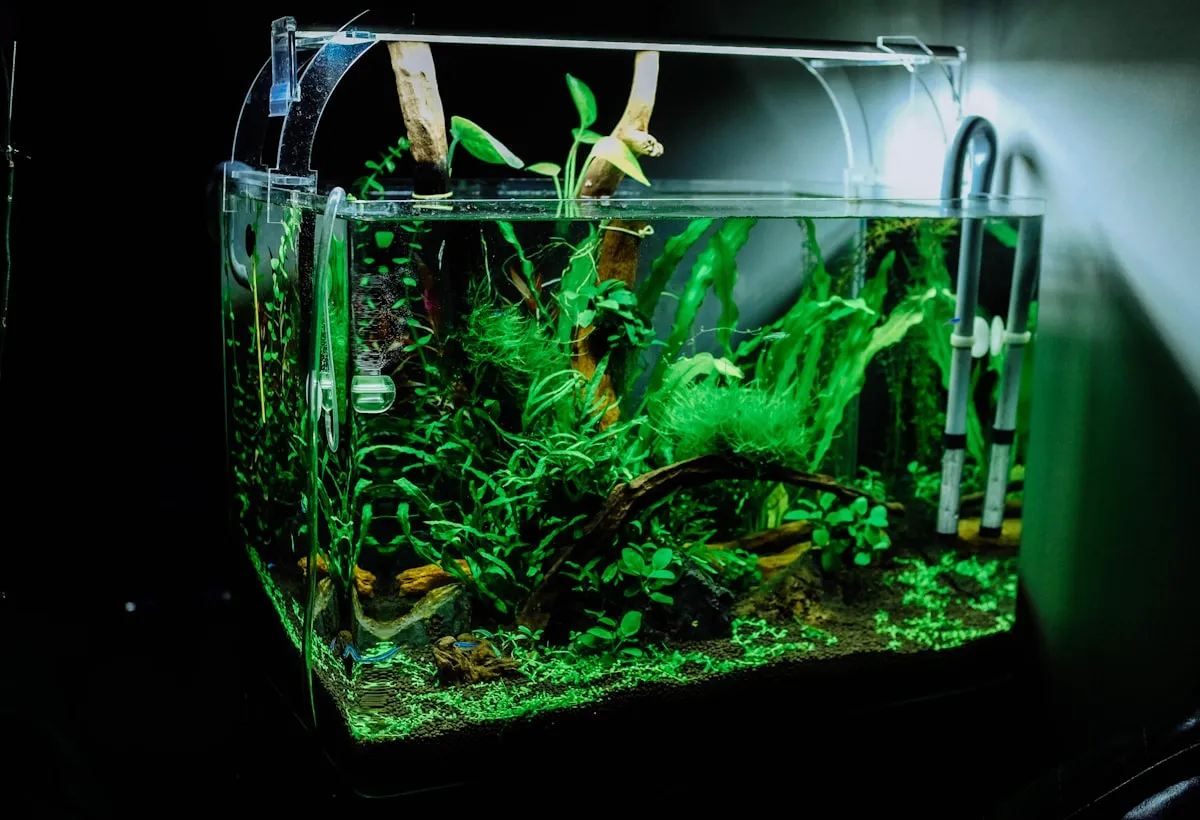
Planted Tank Aquascaping for Beginners
January 10, 2026 · 5 min read · Photo: Huy Phan / Unsplash
Planted Tank Aquascaping for Beginners
If you’ve ever stood in front of a lush, green display tank at a local fish store and wondered how anyone keeps that many plants alive, the good news is that it’s usually less complicated than it looks. Most of the jaw-dropping planted tanks you see online are “high-tech” setups: pressurized CO2, strong lighting, and a daily dosing routine. None of that is required to grow a genuinely nice-looking planted tank. A “low-tech” setup, meaning no CO2 injection, works fine for a wide range of plants and is far more forgiving while you’re still learning the ropes. Here’s how to get started with substrate, lighting, and plant choices, and where CO2 fits in (or doesn’t) for a beginner.
Why Start Low-Tech
In a high-tech tank, light, CO2, and nutrients all have to stay in balance, since too much light without enough CO2 is one of the most common triggers for algae blooms. A low-tech tank sidesteps that balancing act almost entirely. You’re working with less light and no injected carbon, so plant growth is slower but steadier, and small mistakes (a slightly long light schedule, a missed fertilizer dose) rarely tip the tank into an algae mess. It’s also cheaper: no CO2 tank, regulator, or diffuser to buy. Once you’ve got a feel for how your plants grow and how your tank responds to light, you can always add CO2 later if you want to chase carpeting plants or faster growth.
Picking a Substrate
You have two realistic starting points. The first is an inert substrate, plain gravel or sand, paired with root tabs pushed near the roots of heavier feeders. It’s cheap, easy to find, and won’t do anything unexpected to your water chemistry. The second is a nutrient-rich aquasoil made for planted tanks, which comes pre-loaded with nutrients and generally grows plants faster and denser. As a rule of thumb, many aquasoils also tend to soften water and lower pH somewhat, which is great if you’re keeping soft-water fish like most tetras, but worth knowing about if you plan to keep livebearers or other fish that prefer harder, more alkaline water. Either way, aim for around 2 to 3 inches of substrate, a bit deeper at the back of the tank than the front.
Lighting: Less Is More at First
For a low-tech tank, a moderate, full-spectrum LED fixture run for roughly 6 to 8 hours a day is a reasonable starting point, and it’s easier to increase intensity or duration later than to walk back an algae outbreak. Running lights too long or too bright, especially in a brand-new tank, is one of the most common reasons beginners end up fighting algae instead of enjoying their plants. If you’re not sure, start on the lower end and watch how your plants respond over a couple of weeks before adjusting.
Easy Plants That Forgive Mistakes
A few plants are dependable enough that they’re worth building your first aquascape around:
- Java fern and Anubias: attach the rhizome to driftwood or rock with thread or super glue gel rather than burying it in substrate, which can cause it to rot.
- Cryptocoryne species: may “melt” (lose leaves) shortly after planting due to the change in water and light. This is normal and they usually regrow from the roots within a few weeks.
- Amazon sword: a root-feeding plant that benefits noticeably from root tabs in the substrate.
- Java moss and Vallisneria: both spread readily and are near-impossible to kill under normal low-tech conditions.
- Water wisteria and hornwort: fast-growing stem plants that soak up excess nutrients quickly, which helps keep algae in check while your tank matures.
Do You Need CO2? Probably Not Yet
CO2 injection supercharges photosynthesis and lets plants use more light and nutrients, but it also raises the stakes: if the CO2, light, and nutrients aren’t kept in balance, algae tends to fill the gap. Most beginners don’t need it. If you want a small boost, a liquid carbon supplement (such as Seachem Excel or similar products) can help, but dose conservatively at first. Some plants, particularly Vallisneria and certain mosses, can be sensitive to these products at full strength, so it’s worth checking your specific plants before dosing heavily.
Feeding Your Plants
Fish waste supplies some nutrients, but it’s rarely enough on its own, especially for nitrogen, potassium, and trace elements. A weekly dose of a liquid all-in-one fertilizer, at the low end of the label’s recommendation for a low-tech tank, is a reasonable habit to build. If you’re using an inert substrate, root tabs every few months will keep root feeders like swords and crypts happy.
Riding Out the New-Tank Algae Phase
Even a well-planned planted tank still needs to go through the nitrogen cycle before fish go in, and a spike in ammonia or nitrite during that process can feed early algae growth. It’s common to see a bloom of brown diatoms or green film algae in the first several weeks of a new tank. This usually resolves on its own as the tank matures and plants establish themselves, as long as you’re not overdoing light or fertilizer in the meantime. A cleanup crew of nerite snails, amano shrimp, or otocinclus, added once the tank is cycled, can help keep things tidy while everything settles in.
FAQ
Do I need to fully cycle a planted tank before adding fish? Yes. Plants can absorb some ammonia and nitrate once they’re established, but they don’t replace the nitrogen cycle, especially in the first weeks when a new tank has little beneficial bacteria yet.
How many hours a day should my aquarium lights run? For a low-tech setup, 6 to 8 hours a day is a reasonable starting rule of thumb. Running lights longer than that without CO2 supplementation is a common cause of algae in beginner tanks.
Can I have a nice planted tank without CO2 injection? Yes. Plants like Java fern, Anubias, crypts, Vallisneria, and java moss all do well in low-tech, non-CO2 tanks. CO2 mainly helps with faster growth and more demanding carpeting plants.
What’s the easiest substrate for a first planted tank? Plain gravel or sand with root tabs added near heavy feeders is the simplest and least expensive option. A nutrient-rich aquasoil grows plants faster but costs more and can shift water chemistry, so match it to the fish you plan to keep.
- planted tank
- aquascaping
- low-tech aquarium
- freshwater plants
- aquarium lighting
- aquarium substrate
- beginner fishkeeping